According to Dean in Democracy and Other Neoliberal Fantasies: Communicative Capitalism and Left Politics, communicative capitalism is a form of democracy that talks without responding. A democratic government is supposed to give power to the people when it comes to making important decisions, although this does not always happen. For example, when George W. Bush gave his consent to attack Iraq in 2003, he did it without listening to his people. He claimed that he had the right to attack because Iraq had weapons of mass destruction, therefore he wanted Saddam Hussein dead. This attack caused the death of many innocent people and eventually, the soldiers were able to kill the enemy, Saddam Hussein. Although he was dangerous for America, it was never proved that he had weapons able to cause mass destruction. Simultaneously to the attacks, a large number of Americans were showing dissent on the internet. People would write blogs against Bush’s decision. 250,000 people gathered outside of the White House to protest.
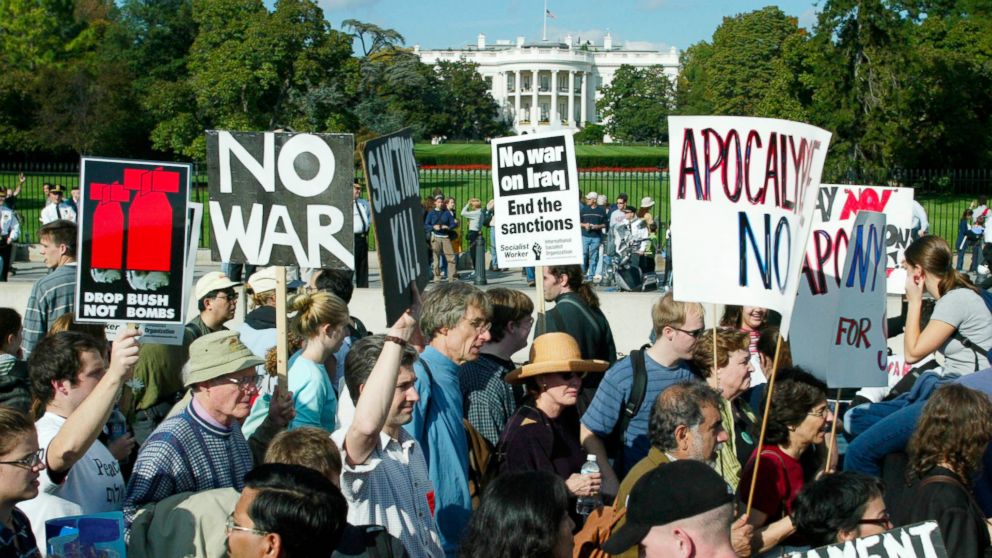
Tom Mihalek/AFP/Getty Images
Thanks to the internet it is possible to materialize ideas and values. Oppositional messages become a more mere contribution to the circulation of images, opinions, and information. Bush acknowledged the protests, but he never replied, nor he blocked the attack. This is an example of communicative capitalism because the people spoke up and their president kept following his path, without listening to his people. Communicative capitalism only applies to social media protests therefore it does not apply to Sardine. They use social media to organize their protests, but their action is take in the squares. They do not use social media to ask for change, they do that by gathering in the cities where Salvini goes to to promote his political agenda. Social media is just their tool to plan protests, while gathering in the squares is their way to make their voices be heard.
How powerful is a smartphone?
According to Schmidt and Cohen, technology created an “interconnected estate”, which is a place that can be accessed by everyone and everywhere in the world using the Internet. The voice of the people can bring change. The internet can be used for good and bad. For example, criminal associations such as Al Qaeda and Mafia use it to recruit people or to threaten democratic institutions. A good way to use technology is, for example, to plan protests and gather people together for a shared cause. The authors of the book emphasize the fact that democratic governments have an obligation to listen to the voices that are raised through the internet. Technology can be the means to bring change, freedom, and equality in the words, but that can happen when people come together because nobody can make progress alone.
Sardine came together to pursue a change and they were able to achieve it. Thanks to technology, the voice of thousands of sardine was heard. They used their social media accounts to recruit people that joined them in the squares. I am sure that without technology they would not have been able to gather so many people together and bring political change. They were, in fact, able to make a change. Before the presidential election in Emilia Romagna, Salvini was supposed to win according to the polls. Once Sardine started gathering in Italian squares, they were able to collect the votes necessary to help the left-wing candidate Stefano Bonaccini and make him win.
References: Schmidt, E., & Cohen, J. (2010). The digital disruption: Connectivity and the diffusion of power. Foreign Affairs, 89(6), 75-85. Democracy and other neoliberal fantasies : Communicative capitalism & left politics. Durham: Duke University Press. (2009).
 Sardine